
"12 years old"
900 article(s) found

POST COFFEE Old Cafe has its own meaning.
Professional barista communication please follow the coffee workshop (Wechat official account cafe_style) in POST COFFEE can stay until 12:00 midnight. (photo by Liu Shih-chia) when it comes to "POST COFFEE", it should be known to experienced coffee lovers, and they must know a few things: besides the delicious coffee and the straightforward personality of the boss, brother Quan, the other is the solid milk foam of real kung fu. Say from

History of introduction and expansion of Coffee in early China (3)
1. Investigation on the year of coffee introduction in Hainan Island in 1898 1.1 the age of the early introduction of coffee in Hainan Island is indisputably expressed as 1908 in many local chronicles, agricultural history, agricultural history and various books and periodicals in China. However, the remains of the century-old coffee trees in Hainan Island are still there, and the descendants of the ancient trees are still there. Therefore, the century-old coffee trees that actually exist in Hainan have unequivocally rewritten Hainan.

Teyou: do you know the 12 oldest cafes in the world? A literary and artistic place to travel.
Coffee is to Europeans what tea is to Chinese, where cafes over a hundred years old are not uncommon, and the one you turn to the corner may have been the place where Hemingway wrote; in the corner where you sat, Beethoven, Picasso, Sartre and Beaufort may have walked into these 12 ancient cafes and tasted a period of ancient history and a wisp of beauty in the dense aroma.

The History of Coffee introduction and expansion in China in the early stage (3)
1. Investigation on the year of coffee introduction in Hainan Island in 1898 1.1 the age of the early introduction of coffee in Hainan Island is indisputably expressed as 1908 in many local chronicles, agricultural history, agricultural history and various books and periodicals in China. However, the remains of the century-old coffee trees in Hainan Island are still there, and the descendants of the ancient trees are still there. Therefore, the century-old coffee trees that actually exist in Hainan have unequivocally rewritten Hainan.

A Survey of Chinese Coffee Culture on the introduction of Coffee in Hainan Island in 1898
1.1 the age of the early introduction of coffee in Hainan Island is indisputably expressed as 1908 in many local records, agricultural history, agricultural history and various books and periodicals in China. However, the remains of the century-old coffee trees in Hainan Island are still there, and the descendants of the ancient trees are still there. Therefore, the actual existence of the century-old coffee trees unequivocally rewrote that the earliest introduction of coffee in Hainan Island should be in 1898. 1.2

The introduction and expansion of Coffee in China in the early stage of Coffee Development (3)
1. Investigation on the year of coffee introduction in Hainan Island in 1898 1.1 the age of the early introduction of coffee in Hainan Island is indisputably expressed as 1908 in many local chronicles, agricultural history, agricultural history and various books and periodicals in China. However, the remains of the century-old coffee trees in Hainan Island are still there, and the descendants of the ancient trees are still there. Therefore, the century-old coffee trees that actually exist in Hainan have unequivocally rewritten Hainan.

ILSI confirms caffeine security code ≠ caffeine intake limit or iron law
For professional baristas, please follow the Coffee Workshop (official account of Wechat cafe_style) ILSI North America Branch, a rigorous systematic review of caffeine published in the Journal of Food and Chemical Toxicology (Food and Chemical Toxicolog) in April 2017. it reconfirms the benchmark conclusion established by Nawrot et al in 2003.
Wine and coffee
Reading Zhang ailing's novels and essays again, I don't know why, I unconsciously remembered the old song "Wine and Coffee" I learned from those 16-or 17-year-old girls when I was about 11 or 12, so I turned on the music and the songs of different women sounded one after another, but they all had a flavor, which should be what people call the amorous feelings of old Shanghai. The age of that city was full of

Coffee raw beans | what's the difference between new beans, old beans and old beans in coffee?
Professional coffee knowledge exchange more coffee bean information please follow the coffee workshop (Wechat official account cafe_style) We all know that when buying coffee beans, we should choose freshly roasted ones, after all, coffee beans will enter the flavor period a few days after roasting! Not only coffee cooked beans, in fact, coffee raw beans are also somewhat fresh and stale, but we call them new beans and old beans.
Botanical characteristics of small seed Coffee
Coffee is a shallow root crop, and the plants propagated by seeds are conic roots. From the point of view of varieties, the roots of small and medium grain species are shallow, while those of large grain species are deeper. Yunnan small grain coffee is a 3-year-old 4-year-old fruit tree with a deep main root of about 70cm.
Characteristics of small-grained coffee trees
Coffee is a shallow root crop, and the plants propagated by seeds are conic roots. From the point of view of varieties, the roots of small and medium grain species are shallow, while those of large grain species are deeper. Yunnan small grain coffee is a 3-year-old 4-year-old fruit tree with a deep main root of about 70cm.

Colombia Coffee Plantation Flavor Description Taste Variety Introduction
Colombia coffee plantation flavor description taste varieties production area introduction in the past 12 to 13 years, coffee country Colombia in order to increase production and income, in the form of national policies to reward improved new varieties (high fruit rate, strong pest resistance, low planting costs), and even in some areas of semi-mandatory requirements to cut down old varieties to plant improved species. Under these conditions, to protect small yields
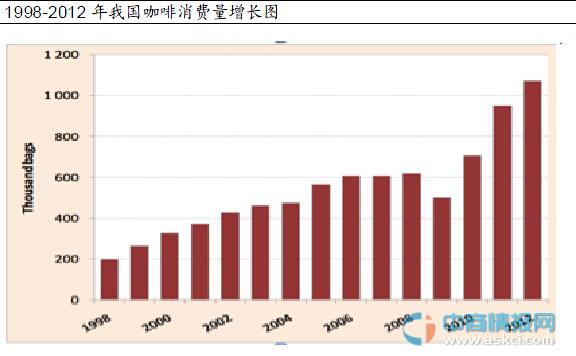
Analysis of China Coffee Consumption Market in 2015
1. Changes in coffee drinking volume and drinking structure in China: compound 13% growth, instant-ready to drink-fresh grinding From 1998 to 2012, coffee consumption in China increased from 199,000 bags to 1.1 million bags, with an annual growth rate of about 12.8%. China has a population of about 1.3 billion, and coffee consumption has risen from 9.6 grams to 47.6 grams, with an average annual growth rate of about 12.1%. If the growth rate of 12.8% is maintained, the deadline

Which kind of beans have a special flavor, such as aged Mantenin, aged Sulawesi or aged Java?
Professional coffee knowledge exchange more coffee bean information please follow the coffee workshop (Wechat official account cafe_style) ◎ aged coffee Aged Coffee maybe you have heard of coffee raw beans put long does not matter; it will become old coffee, the taste will be better. As a matter of fact, such a statement is wrong and quite irresponsible. Beans will rot if they are kept for too long; they will be fresh green.

Old beans? A brief introduction to the description of flavor, taste and aroma characteristics of aged Mantenin
Not all coffee beans are suitable for storage as aged beans, and the raw beans that are usually selected for storage must have a strong physique. Therefore, the coffee beans produced in Indonesia's three important and well-known producing areas, Sumatra Mantenin, Sulawesi and Java, are the best choice for making aged coffee, especially the aged Mantenin.

Can Lu Zhengyao copy the next "Rui Xing" game successfully?
After losing the coffee market, the 52-year-old Lu Zhengyao still feels that his knife is not old. On May 12, the news of "Luckin Coffee founder Lu Zhengyao re-starting a business" almost became the focus of attention of the whole network, while media sources pointed out that Lu Zhengyao's re-entrepreneurial style will replicate what he did on Shenzhou chauffeured car and Luckin Coffee. According to public information, Lu Zhengyao was born in Fu in July 1969.

Botanical characteristics of small seed Coffee
1. Root coffee is a shallow root crop, and the plant propagated with seeds is a cone root system. From the point of view of varieties, the roots of small and medium grain species are shallow, while those of large grain species are deeper. Yunnan small grain coffee is a 3-year-old 4-year-old fruit tree with a deep main root of about 70cm. The lateral root that grows horizontally from the main root is called the horizontal lateral root, the vertical lateral root grows downward, and the root extracted from the lateral root is called the secondary lateral root.
Yunnan Coffee·Search for Zhu Kula
Note: as part of the humen coffee trail, although the journey has been a long time ago, temporarily archived. 1. Introduction to the itinerary 2010.12.20 Binchuan County, Dali, Kunming (transportation mode: Kunming West Passenger Station Kunming-Binchuan) 2010.12.21 Zhukula Village Committee, Pingchuan Town, Binchuan County (transportation mode: Binchuan County Short-distance City Passenger Station County-Pingchuan Minibus)

What is the difference between aged coffee beans and Indian monsoon coffee? What are the characteristics of old coffee?
Professional coffee knowledge exchange more coffee bean information please pay attention to the coffee workshop (Wechat official account cafe_style) old Sumatran coffee beans with a unique flavor, has always been the core of Starbucks coffee, but also where coffee enthusiasm lies. Through the unique process of coffee production until the cup of coffee in your hand, the care you put into it makes you taste five times every time you taste it.
Botanical characteristics of small Grain Coffee in Yunnan
1. Root coffee is a shallow root crop, and the plant propagated with seeds is a cone root system. From the point of view of varieties, the roots of small and medium grain species are shallow, while those of large grain species are deeper. Yunnan small grain coffee is a 3-year-old 4-year-old fruit tree with a deep main root of about 70cm. The lateral root that grows horizontally from the main root is called the horizontal lateral root, the vertical lateral root grows downward, and the root extracted from the lateral root is called the secondary lateral root.